What Does “Family-Centered ABA” Really Mean? A Guide for Indiana Parents
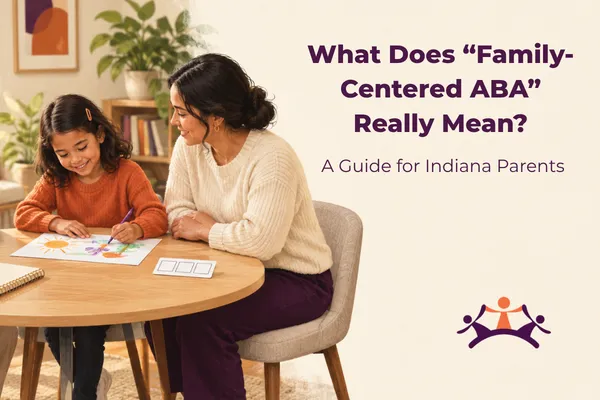
Family-centered ABA is an approach to Applied Behavior Analysis that brings caregivers into decisions about goals, strategies, and progress while considering the child’s preferences, needs, and everyday environment. For Indiana parents, it should mean a care plan that supports meaningful skills at home and in the community—not simply a list of tasks completed during therapy.
The phrase sounds reassuring. But what does it look like on a busy school morning, during an exhausting bedtime routine, or when an older child needs support that no longer fits an early-childhood model?
Those are the situations where family-centered care should become practical.
Family-Centered ABA at a Glance
Families help identify priorities rather than only receiving a finished plan.
Goals connect to communication, safety, participation, and everyday routines.
Caregiver coaching includes explanations, practice, and problem-solving.
The child’s communication, comfort, choices, and dignity matter.
Recommendations account for family schedules, resources, and capacity.
Progress is reviewed collaboratively, and plans change when needed.
Family-Centered ABA Is More Than Parent Updates
Receiving a progress report is useful. Knowing what happened during a session is useful too. But neither automatically makes care family-centered.
A family-centered approach involves collaboration before, during, and after treatment decisions.
The clinical team brings expertise in assessment, learning, behavior, and treatment planning. Caregivers bring knowledge of the child’s history, routines, strengths, communication, and daily challenges. The child brings their own preferences, responses, interests, and ways of communicating.
Together, that information helps answer a practical question:
“What would make everyday life safer, more accessible, and more manageable for this child and family?”
Family-centered care does not mean parents must design treatment themselves. It means their knowledge helps shape clinically appropriate decisions.
1. Goals Start With What Matters in Daily Life
Two children with the same diagnosis may need very different goals.
One family may need help with a child leaving the house unexpectedly. Another may want to address communication during meals. A teen may need support participating in personal-care routines or community activities.
Useful questions include:
Which parts of the day are most difficult?
Where does your child need more support?
What does your child enjoy?
How does your child communicate needs or discomfort?
What safety concerns are present?
Which changes would make the biggest practical difference?
Translate Broad Hopes Into Specific Skills
A goal such as “better mornings” is meaningful, but it needs clarification.
A hypothetical family might identify a more specific priority: helping a child communicate when getting dressed is uncomfortable and follow a short morning sequence with support.
Another family might focus on a teen requesting help during a household task instead of abandoning the activity in frustration.
These are illustrative examples, not patient stories. They show how broad concerns can become individualized skills without assuming every child needs the same plan.
2. The Child Remains at the Center
Family-centered does not mean adult convenience takes priority over the child’s well-being.
A thoughtful plan considers the child’s interests, communication, comfort, choices, and signs of distress. Goals should improve meaningful access, safety, participation, or independence—not make a child appear less autistic.
For example, a child should not have to make eye contact to show they are listening. Harmless self-regulatory movements should not automatically become treatment targets simply because they look different.
When a child resists a task, the team should explore what may be contributing. The difficulty could involve communication, sensory discomfort, task complexity, pain, anxiety, or another concern requiring additional assessment.
Behavior-analytic care should not replace medical evaluation when pain, illness, or a sudden change may be involved.
3. Caregiver Coaching Should Feel Like Support
Parents should not receive a complicated instruction sheet and be expected to figure out the rest alone.
Useful caregiver coaching can include:
Explaining why a strategy is being recommended.
Demonstrating how it works.
Providing opportunities to practice.
Offering feedback without blame.
Creating a short written or visual reminder.
Reviewing what happened at home.
Adjusting the approach when it is not practical.
The question is not, “Did you carry out every step perfectly?” It is, “What helped, what got in the way, and what should we change?”
Start With Something Manageable
A family already struggling with school, work, transportation, and sleep may not be able to add several new routines at once.
One focused priority can be more practical than a long assignment list.
For example, caregivers might start by learning how to support a request for a break during one daily activity. The team can then review whether the strategy is understandable, useful, and appropriate before expanding it.
Family participation matters, but it should not turn parents into full-time therapists.
4. Skills Need to Work Outside Therapy
A child may demonstrate a skill during a session and still need support using it elsewhere.
Generalization means using a learned skill across different people, places, or situations. Maintenance means continuing to use it over time.
These concepts matter because everyday life rarely looks exactly like a therapy session.
A child who requests help with one clinician may need practice requesting help from a caregiver. A teen who follows a checklist in one setting may need an adapted version for their bedroom, bathroom, or school bag.
Ask your provider:
How will this skill apply at home?
What supports will we need?
How will we know whether it is carrying over?
What changes if it works in therapy but not elsewhere?
Home carryover does not necessarily mean the provider offers in-home services. It means treatment planning considers how skills can become useful beyond the treatment setting.
5. Family Capacity Is Part of the Clinical Picture
Recommendations need to fit the circumstances in which families will use them.
A household may be managing:
Multiple work schedules.
Siblings with different needs.
Transportation barriers.
A recent move or separation.
Caregiver illness or exhaustion.
Financial pressure.
School changes.
Limited support from extended family.
These are not excuses or signs that parents do not care. They are real conditions affecting what a plan can reasonably require.
Tell the team when something is not sustainable. A useful conversation might sound like:
“We can practice this after dinner, but mornings are not workable.”
Or:
“I understand the goal, but I need you to show me what it looks like when both children need help.”
The plan should be open to problem-solving, not built around an imaginary household with unlimited time.
6. Progress Should Be Clear and Meaningful
Data helps clinicians determine whether a strategy is working. Families also need to understand what those measurements mean.
Ask for explanations in plain language:
What skill are we tracking?
What counts as progress?
How much support does my child still need?
Is the change happening outside sessions?
Is the routine less distressing?
What happens if progress stalls?
A change in a number does not tell the entire story. A child may complete a routine more often but remain highly distressed. Another may need the same amount of assistance but communicate discomfort more clearly.
Both the measured skill and the child’s experience deserve attention.
No provider can promise a specific outcome or timeline. Family-centered care should offer clear goals and honest review—not guarantees.
What LCSW Leadership Adds to Great Heights’ Approach
Great Heights ABA includes Licensed Clinical Social Work expertise in clinical leadership, case staffing, and consultation.
A Licensed Clinical Social Worker, or LCSW, brings a perspective that considers mental health, relationships, family circumstances, and environmental stressors.
Alongside behavior-analytic expertise, that perspective can help a team consider the wider context around a child’s needs: family stress, major changes, trauma-related considerations, and barriers that may affect daily routines or follow-through.
This does not mean every ABA client receives psychotherapy, nor does it replace medical or mental-health services when those are needed. It means Great Heights’ clinical conversations include a broader whole-family lens.
Family-Centered Care Also Matters for Older Children
A family-centered plan should evolve as a child grows.
For older children and teens, priorities may include:
Communicating preferences and boundaries.
Participating in age-appropriate household routines.
Managing personal belongings.
Building personal-care skills.
Practicing community safety.
Asking for assistance or a break.
Preparing for changing school and family expectations.
Great Heights ABA does not use an age cut-off. The team works with older children, teens, and complex cases, including families who have had difficulty finding the right provider.
That does not guarantee acceptance, funding, availability, or a particular outcome. It does mean age or complexity alone is not the end of the conversation.
A Simple Framework: Priority, Plan, Practice, Review
Use these four questions to make a conversation with your ABA team more concrete:
Priority: What matters most to our child and family right now?
Plan: What specific skill or support are we working on?
Practice: Where can we try it realistically, and what help do we need?
Review: What changed, what did not, and what should happen next?
For a difficult after-school transition, the priority might be reducing distress and supporting communication. The plan might include a predictable snack and break routine. Practice could begin on a few manageable afternoons. Review would consider both the child’s response and whether the routine is sustainable.
This is a discussion framework, not a treatment protocol. Your child’s clinician should individualize recommendations.
What Indiana Parents Can Ask Before Starting Care
Rather than asking only, “Are you family-centered?” ask:
How will our priorities influence treatment goals?
How will you include our child’s preferences and communication?
What does caregiver coaching look like?
How do you adjust recommendations to fit our schedule?
How will skills carry over at home?
How do you handle disagreements or concerns?
What happens when a strategy is not working?
How do you support older children or complex cases?
Listen for specific explanations. “We involve parents” should lead to a clear description of what involvement means.
Frequently Asked Questions
What Is Family-Centered ABA?
Family-centered ABA includes caregivers in treatment decisions and considers the child’s needs, preferences, daily environment, and family circumstances when developing and reviewing goals.
Does Family-Centered ABA Mean Parents Provide All the Therapy?
No. Clinical professionals remain responsible for treatment within their roles. Caregiver coaching helps families use selected strategies in everyday routines without expecting them to become full-time therapists.
Can Families Help Choose ABA Goals?
Yes. Families should share priorities and concerns so the clinical team can develop appropriate, measurable goals connected to meaningful daily needs.
What If a Strategy Does Not Work at Home?
Tell the clinical team what happened and what made it difficult. The provider should help assess the issue and adjust the approach rather than assume the family is at fault.
Does Great Heights ABA Work With Teens and Complex Cases?
Yes. Great Heights serves older children and teens without an age cut-off and considers complex behavioral needs. Individual fit, clinical needs, funding, and availability still require review.
Let’s Talk About What Your Family Needs
If you’re looking for family-centered ABA therapy in Indiana, start with a conversation about what matters most to your child and household. We’re happy to talk through your questions and explore your options.
Ask us your questions today. We're here to help.